We have been having fun learning about force and motion. Recently we spent an afternoon doing experiments. Kim and Luke love science, and couldn't wait to repeat these experiments when Dad got home. These experiments all came from the Young Scientist Club Kit #33.
Showing posts with label experiments. Show all posts
Showing posts with label experiments. Show all posts
Saturday, November 1, 2014

Thursday, July 17, 2014
Water's Tensile Strength--Water Science

Today we did an experiment...an oldie but a goodie...What makes it even more fun is the fact that this bunch of kids have never done these particular water experiments before. I forget sometimes that even if something has been done in our homeschool before there are several children who may not have experienced it before.
This time we took a guess has to how many water drops we could get to stay on the top of a penny, (or nickel or quarter) The guesses ranged from 8 to 10, which, with 4 kids making hypothesis surprised me. I think they were influenced by each others guesses.

If fact, the highest number of drops was 19. We learned about tensile strength and the fact that water definitely has "strength" on the outside "skin" of the water.

Once the water started to flow, it all flowed off the penny.
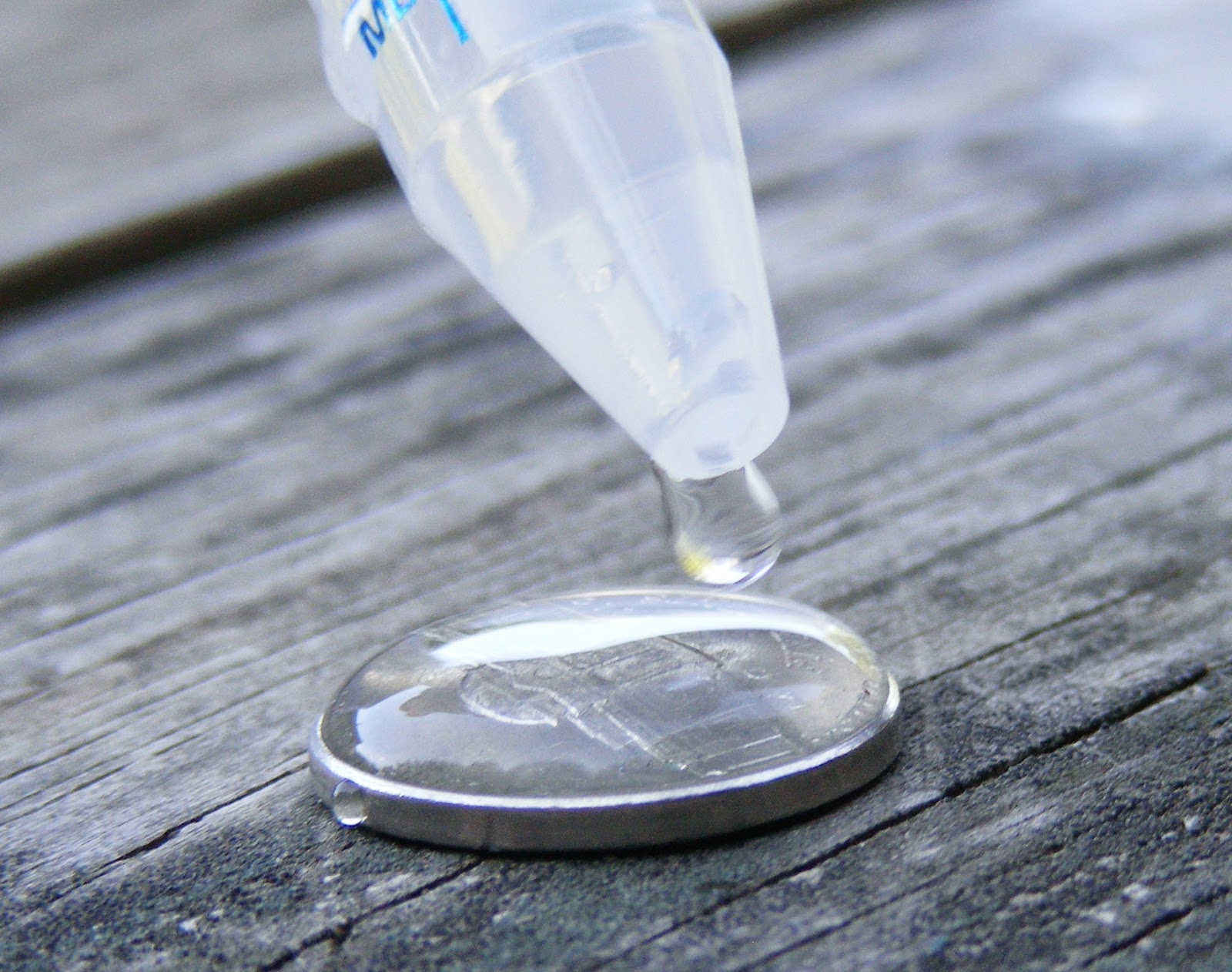
31 drops were put onto a nickel. (This surprised me!)

We then tried a new to us experiment.
We filled a jar to the very top. Next, drop pennies gently into the jar, trying not to disturb the water.

Mark managed to drop 36 pennies into the jar. In the process a beautiful dome of water rose above the rim of the jar. The 37th penny sent the water flowing from the jar.

And what does dish detergent do to the surface of the water.
Sprinkle a bowl of water liberally with pepper.
Dip a toothpick covered with dish detergent into the center of the pepper.
Watch the "magic" happen....or is it science??
Wednesday, July 11, 2012
Does Sunscreen Really Work??--an experiment

We have had nothing but sunshine and hot temperatures for the last month...in fact, we are in the middle of a drought. This past week, Laura received a terrible sunburn, so I set out to demonstrate the importance of sunscreen use. I saw this experiment somewhere out there in the world wide web.
Fold a piece of black construction paper in half.
Cover one side of the paper with sunscreen...we used 50 spf...We went a little overboard with the sunscreen, after the initial globbing...we rubbed most of it off the paper.

After about 2 hours in the sun, we found these very impressive results....sunscreen definitely protected the paper for the suns harmful rays.

After using the construction paper, I wondered what results we would get using our sun sensitive paper.

At first, I made a traditional sunprint.

Scissors...The paper begins dark blue...what the sun hits, it lightens, leaving a great print of the scissors.

We then made a circle with sunscreen on the paper and then headed outdoors.

After a couple minutes, these were are results...Sunscreen once again provided plenty of protection against the sun.

Make sure you wear your sunscreen everyone!!


Saturday, March 19, 2011
We Made Worms--- Fun Science Sunday
 I have to thank Steve Spangler science for this weekends fun science experiment. We had quite a bit of ingredients left from last years Leprechaun Fun Science kit--so tonight we made worms.
Insta-Worms are created through an amazing reaction involving a polymer taken from seaweed and combined with a little salt to produce instant worms.
First we measured the water into the dish and then measured the "worm activator" powder into the water.
Stir until completely dissolved.
 Squeeze the "worm goo" into the water and activator....and instantly---you have made a worm.
 I love the looks of concentration on my little scientists' faces.
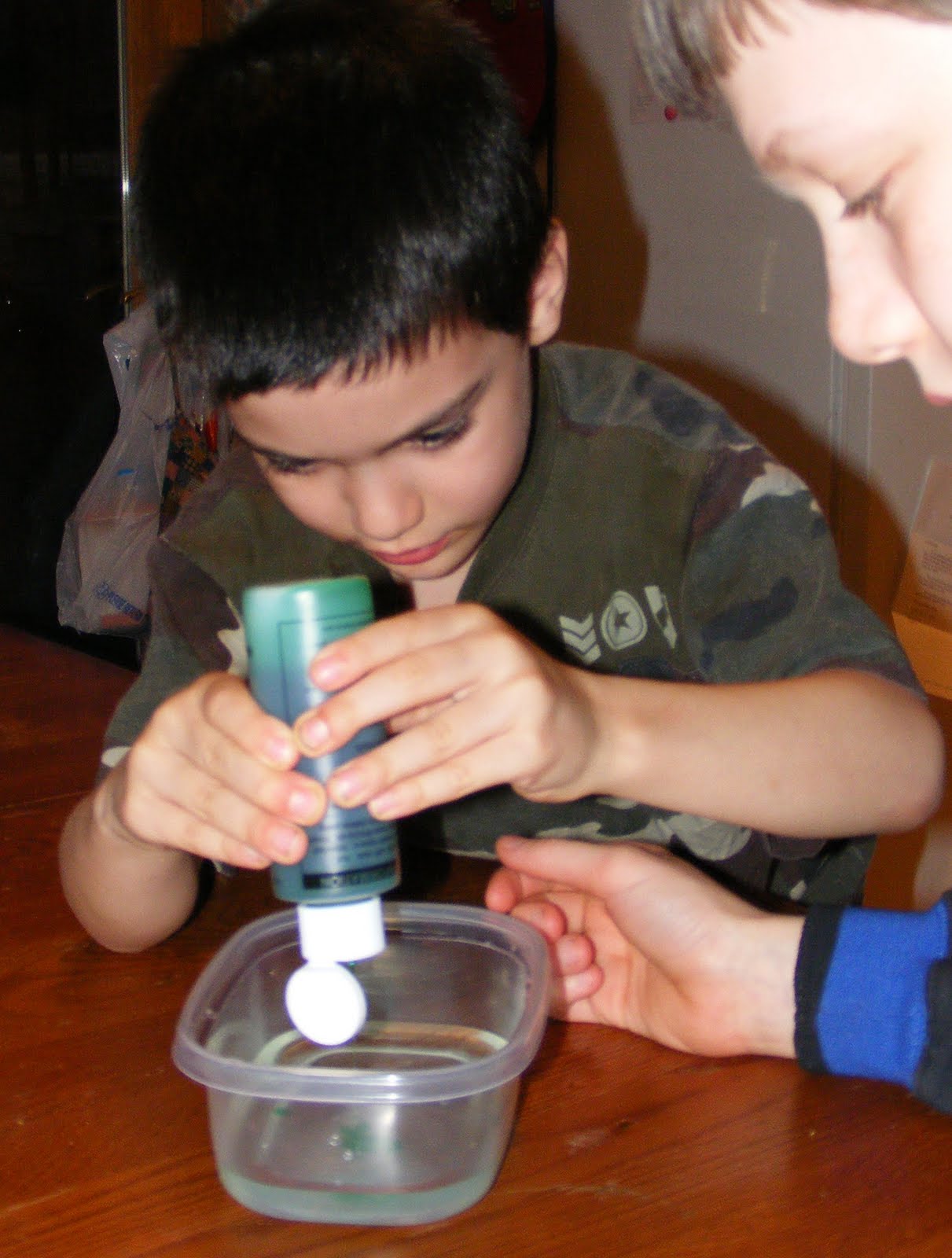
 We also discovered that pickle juice also works as a worm activator.
 Polymers ROCK!!


Sunday, March 13, 2011
Fun Science Sunday
This week's Science Sunday comes directly from Steve Spangler Science.

Items needed: jar or glass
coins
index card
interested small children
The object of this experiment was to get the coin into the jar without touching the coin.
 We got a penny into a jar without touching it, using Newton's Law of Inertia.
The first Law of Motion states that an object at rest will remain at rest unless an outside force acts upon it. When you "flick" the card---on an even path---out from under the coin, there is no force on the penny, only on the index card.
This has great WOW! appeal. Sure to impress all the big brothers and sisters---and even the grandparents.
Saturday, January 22, 2011
Science Sunday---Invisible Ink
 This is a real neat science kit....with many fun experiments.
 Today we started out learning about acid and bases...using the litmus paper included in the kit.
The projects are first "performed" as magic tricks and then are explained scientifically.
 Gracie prepared 2 tests tubes. One with a water and citric acid solution and another with water and baking soda.
First we wrote on the paper with the base (baking soda solution). The paper immediately turned red....we then wrote over the red with the acid (citric acid solution)....the red "magically disappeared.
 We learned how litmus paper works---this led to more experimenting with acid and bases.
 We learned what happens with when you mix acid and bases.....
 it makes a great reaction....and a quite messy reaction.
This also led to the discussion of writing with invisible ink.
We recently read a book where the heroine reads a message that was written with lemon juice.
We had to give it a try.
This is dangerous....no child, no matter what age, should do this without adult supervision.
(In fact, I lit my living room rug on fire doing this when I was 12 years old---luckily, that was all that caught on fire.) Mark and Grace first wrote their names in lemon juice on regular computer paper.
We let the lemon juice dry---it was invisible.
I used one of my candles which has burned down quite low so that the paper would be a "safe" distance from the fire.
Placing the paper over the heat of the flame made the "invisible ink" appear, revealing writing.
 Kim and Luke wandered in and needed to get in on the experiment.


Placing the paper over the heat of the flame made the "invisible ink" appear, revealing writing.
 Kim and Luke wandered in and needed to get in on the experiment.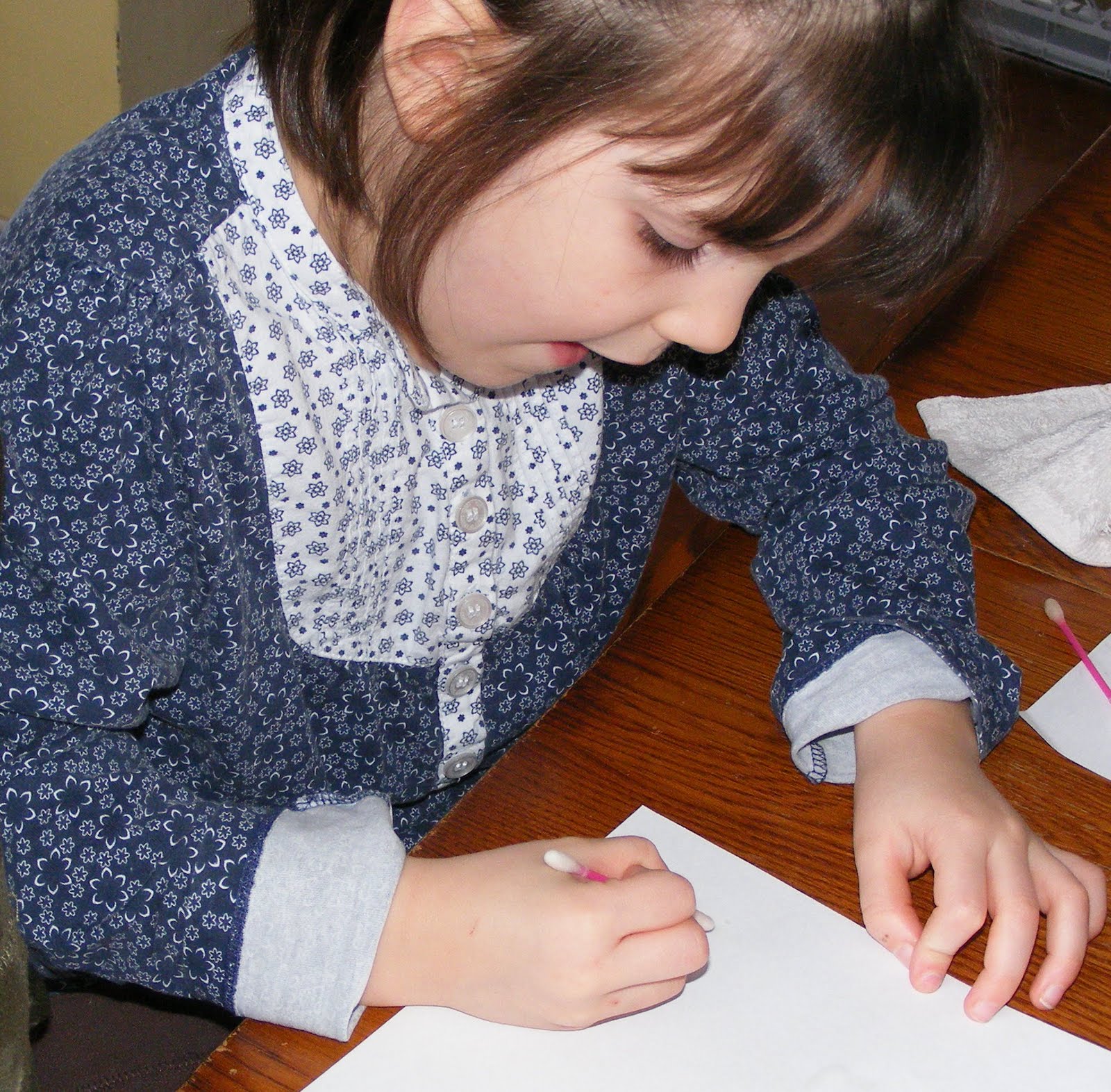

The final invisible results....very fun science!!
Tuesday, August 24, 2010
A Bubbling Lava Lamp--Science Rules

 Another great experiment from Steve Spangler.
It takes just some everyday products---(although I have never had Alka-Seltzers in the house before)
 Our jumbo test tubes are also from Steve Spangler Science.
Fill test tube, or a soda bottle, 3/4 full of vegetable oil.
Fill up the rest of the test tube with water.
This is a great time to talk about the fact that water is more dense than the oil.
 Add about 10 drops of food coloring to the test tube.
It is fun to watch the water based food coloring "float" through the oil and then mix into the water at the bottom of the test tube.
 Divide the Alka-seltzer into about 8 pieces.
The reaction is great!!
The Alka-seltzer reacts with the water, forming carbon dioxide gas. The bubbles of gas rise to the surface of the tube. The gas bubble pops at the surface and then the water drops back to the bottom of the test tube.
 We have been repeating this with additional pieces of Alka-seltzer all day.
It works again and again.

 After our reactions settled down, the kids enjoyed using the test tubes as their own ocean wave bottles.
 Our jumbo test tubes are also from Steve Spangler Science.
Fill test tube, or a soda bottle, 3/4 full of vegetable oil.
Fill up the rest of the test tube with water.
This is a great time to talk about the fact that water is more dense than the oil.
Add about 10 drops of food coloring to the test tube.It is fun to watch the water based food coloring "float" through the oil and then mix into the water at the bottom of the test tube.
 Divide the Alka-seltzer into about 8 pieces.
The reaction is great!!
The Alka-seltzer reacts with the water, forming carbon dioxide gas. The bubbles of gas rise to the surface of the tube. The gas bubble pops at the surface and then the water drops back to the bottom of the test tube.
 We have been repeating this with additional pieces of Alka-seltzer all day.
It works again and again.

 After our reactions settled down, the kids enjoyed using the test tubes as their own ocean wave bottles.


Subscribe to:
Posts (Atom)