Showing posts with label water experiments. Show all posts

Wednesday, July 30, 2014

A Water Balloon in a Bottle

 More water fun, with a little air pressure thrown in. 
I saw this on the Steve Spangler web site.
Put a balloon into a 1 liter bottle.
 Try and blow it up...you can't.  The bottle is not empty. It is full of air that takes up space.  The balloon cannot expand.
 Use a pushpin to put a hole into the bottom of the bottle.
Now try and blow up the balloon.
 You can do it!  The air in the bottle goes out the hole in the bottom of the bottle.
(It is hard to blow up, but you can do it)
Next, take your finger, or duck tape and cover the hole...the air remains in the balloon, even with the cover off the bottle.
While still holding your finger over the hole, fill the balloon with water.
 Go outside.  This could be a trick that you can play on someone, but we all watched the video on the Steve Spangler site so we were ready.
 Remove your finger (or the duck tape) from the bottle....air rushes into the bottle through the hole and forces the water out of the balloon.
After our original trick, we filled the balloon with water again.  With Amy's help, I got it tied off without having a shower.  Now we have a water balloon in a bottle.
This can really stump people.
Have fun with science!

Tuesday, July 22, 2014

Fire-Resistant Water Balloons--Water science

 This morning I found this neat experiment on the Steven Spangler website.
Perfect for a summer afternoon...although I was very doubtful that it would work.
You need:
An adult
balloons
candle
lighter
water

 
This first video shows what happens when Gracie holds a air filled balloon over a candle flame.
POP!!
Next, fill a balloon with water and then blow it up.
One of the first balloons with water---about 1/4 of a cup of water--was brought into the house, (the tub to be exact) because we couldn't keep the candle burning.
Amazingly, it did not pop...and we held it over the flame--where the water was--for several minutes.
I was impressed.
 
Then Daddy got home, and we had to shown him this amazing sight.
He decided to fill up a water balloon and have at it directly with the lighter.
It would not pop....it balloon wouldn't melt, (like I thought it would)  We tried to get it to pop for at least ten minutes.

 
Look at that soot.  That is not damage to the balloon, but soot from the flame.
Science is amazing!
Taken directly from the Steven Spangler website, here is the explanation of this experiment:

"How Does It Work?

Water is a great substance for soaking up heat.  The thin balloon allows the heat to pass through very quickly and warm the water.  As the water closest to the flame heats up, it begins to rise and cooler water replaces it at the bottom of the balloon. This cooler water then soaks up more heat and the process repeats itself. In fact, the exchange of water happens so often that it keeps the balloon from ever popping! The soot on the bottom of the balloon is actually carbon.  The carbon was deposited on the balloon by the flame, and the balloon remains undamaged." Steven Spangler


Sunday, July 20, 2014

Which is more dense--salt water or fresh water?

 I found another great water experiment.
Which is heavier, salt water or fresh water?
Supplies needed:
2 clear glasses
water
salt
ice cubes
food coloring
spoons
 Fill the glasses 3/4 the way full.  Our glasses held about 1 cup of water each.
 Add 2 tablespooons of water to one of the glasses.
 stir well
 Add ice cubes to each glass.
 We added food coloring to the salt water solution first.
 This is what it looked like.
 Then, Kimberly added food coloring to the fresh water glass.
 This is what it looked like.
Conclusion:  The ice melted slightly in each glass--leaving fresh water on the top surface of the salt water.  The salt water is heavier than the fresh water--the food coloring stayed on the top, in the fresh water.  The food coloring in the fresh water spread into the water immediately.
And that proves that salt water is more dense than fresh water.

Thursday, July 17, 2014

Water's Tensile Strength--Water Science

 Today we did an experiment...an oldie but a goodie...What makes it even more fun is the fact that this bunch of kids have never done these particular water experiments before.  I forget sometimes that even if something has been done in our homeschool before there are several children who may not have experienced it before.
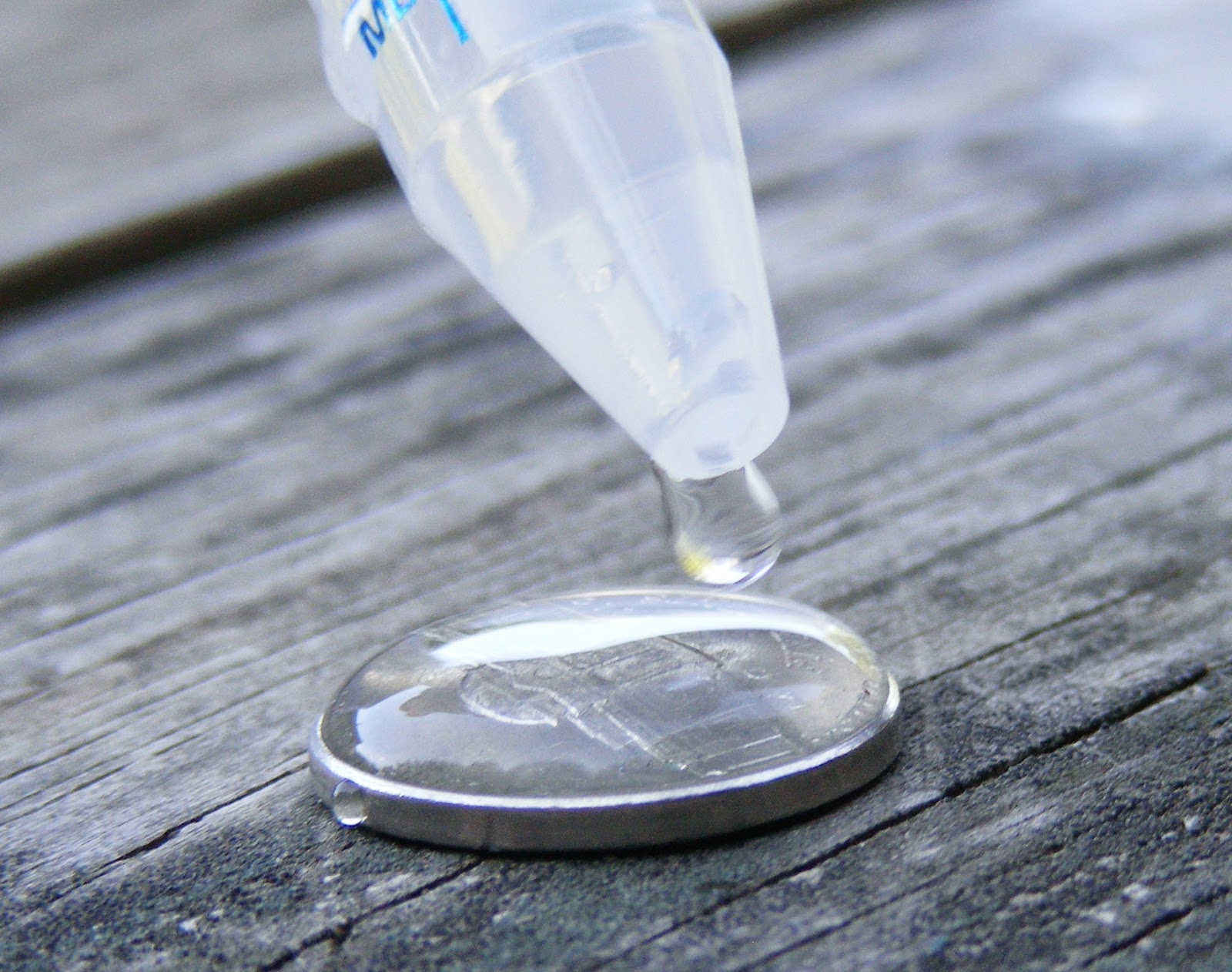
This time we took a guess has to how many water drops we could get to stay on the top of a penny, (or nickel or quarter)  The guesses ranged from 8 to 10, which, with 4 kids making hypothesis surprised me.  I think they were influenced by each others guesses.
 
 If fact, the highest number of drops was 19.  We learned about tensile strength and the fact that water definitely has "strength" on the outside "skin" of the water.
 Once the water started to flow, it all flowed off the penny.
 31 drops were put onto a nickel.  (This surprised me!)
 We then tried a new to us experiment.
We filled a jar to the very top.  Next, drop pennies gently into the jar, trying not to disturb the water.
 Mark managed to drop 36 pennies into the jar.  In the process a beautiful dome of water rose above the rim of the jar.  The 37th penny sent the water flowing from the jar.
 And what does dish detergent do to the surface of the water.
Sprinkle a bowl of water liberally with pepper.
Dip a toothpick covered with dish detergent into the center of the pepper.
Watch the "magic" happen....or is it science??

Tuesday, July 15, 2014

Water Experiments--Colorful Dissolving Candy--Kitchen Science

 I found a few candy experiments over at the Steven Spangler blog.  This one with Gobstoppers is great for having the kids make a hypothesis.  Will the colors mix, which color dissolves faster, what happens when a new color is reached?
 I love how these colors have such distinctive edges...the colors do not mix! (not our hypothesis)
 Once the next color is reached, the more colors are in the bowl, yet separate.
 Our bowl after the next color in the gobstopper has been reached.
This is an easy, fun experiment with water.
 Another fun water and candy experiment is the M&M experiment.
What happens when the water dissolves the candy coating on the outside of an M%M?
Something pretty cool.
 The water of the dissolved colors was great, but the biggest science discovery is the fact that the printed letter "m" does NOT dissolve in water. Above and below you can see the "M's" floating in the water.
Tomorrow I will be back to post about the opening of our new Green Kid Crafts box.
This months box was "Water Science". We have every aspect of it.

Saturday, February 27, 2010

What My Children are Reading: WATER by--Tara

We recently had the great excitement of winning this unique book from a giveaway at Live, Learn, Love.
Tara has a series of books that came about from the fact that she has a son with autism. These books, with their simple subject matter and beautiful, glossy 8x10 photographs, are perfect for encouraging verbal practice with our youngest learners.
Even if your toddlers and preschoolers have no learning difficulty, these books get your child talking and discussing the wonderful photos and subject matter.
The book Water begins with a lovely poem. Even my older children enjoyed this.
The poem is full of adjectives, which we talked about with my early elementary aged kids. (since we are learning about this in our homeschool work)
Also with my older kids, we discussed which adjectives described the different pictures, and also thought of other adjectives that could be used to describe water.
After enjoying our new book, we had some fun with some "magic" water tricks.
Of course, for the school kids, these could be science lessons, but I decided to concentrate on the littles, and just enjoyed the mystery and surprise of these activities.
The first activity was the magic pepper in water trick.
Simple fill a white bowl halfway with water and then liberally shake pepper on top of the water.
Give your child a toothpick which has been dipped into dishwashing liquid.
When the toothpick touches the center of the pepper, the pepper "magically" repels away from the toothpick.
This experiment has a big WOW factor for little ones. (Make sure you have a lot of pepper , because this is done over and over again--if your kids are anything like mine--especially is big kids notice. Even my teenagers had to give it a try. Make sure to rinse out the bowl before trying this a second time to remove any dish detergent residue.)
At the bottom of this post you can see a little video of this.
Our next magically trick was to try and pick up an ice cube with a piece of string.
Again, fill a bowl halfway with water and then add some ice cubes.
This also served as a time to discuss the different states of water.
Try as they may, Kimmy, Gracie and Luke could NOT pick up the ice cubes with string.
And then, it was time for the "magic" ingredient.
I took regular table salt and shook it over the ice cubes and strings.
Make sure the strings are laying across the ice as you add the salt.
TA-DA!! It worked. "Magic" worked again. You will notice that Luke brought up TWO ice cubes. One of those cubes were Kimmy's.
This caused problems! Loud--problems!!


So, Kimmy got to try again. We got her a new ice cube, placed her string perfectly on top of the cube, and then Luke poured a generous amount of salt onto the ice cube.

Kimmy added a little more salt for good luck.

SUCCESS!!!!
Was she a proud and excited girl!!


Don't miss our great pepper experiment video!
Also don't miss checking out Books By Tara--you will be glad you did!!
You can check out many of our other water experiments that we have done in the past by clicking on this link.
Head on over to Mouse Grows, Mouse Learns for my What my Child is Reading posts.

Monday, March 16, 2009

Water-The Unplugged Project of the Week

"Water, water everywhere, nor any drop to drink." Rime of the Ancient Mariner
This line kept going through my head all the past week as I was thinking about the Unplugged theme of the week-WATER. I wasn't up to diving into this epic poem, so I settled on some fun water experiments.

Our first experiment is a magic toothpick trick, which showed us how dish detergent breaks the surface tension of water.
We needed:
six toothpicks
dish detergent
a pie plate of water
At first we arranged 5 toothpicks into a pentagon in the pie plate of water.
It took some patience to form this pentagon, but we did it.
We then dipped the 6th toothpick into dish detergent.
When we poked this toothpick into the water at the center of our pentagon,
the pentagon toothpicks immediately floated away from each other. We learned that the soap broke the surface tension of the water, making the molecules of water break apart from each other. We see this when the toothpicks spread out.
Another fun surface tension experiment is seeing how many drops of water you can get on the top of a penny with a dropper.
First, we took guesses as to how many drops the pennies would hold. The kids guessed one or two.
It was very exciting and impressive when we managed to put 24 drops of water on the top of a penny. We carefully checked out our dropper and 20 drops is about 1 ml. We could see the surface tension of the water holding actually over the edge of the pennies.
We learned that water molecules are so attracted to each other the want to stay "stuck" together. If we poked the water with the tip of a toothpick, the tension was broken and the water flowed off the penny.
VERY COOL!
Becky set the record with 29 drops of water on a penny.
We then set out to find out why they put salt on our roads in the winter.
Using a:
bowl of water
string
table salt
ice cubes,
we discovered how to lift an ice cube with a string.
We put the ice into the water, laid the string on top of the ice, and then shook salt onto the string and ice.
After waiting about a minute, TA DA, the string picked up the ice.
The salt lowers the freezing point of water. The ice melts around the string and then refreezes with the string frozen to the ice.
Gracie did it,
and so did Luke.
Make sure you go and check out all of this weeks Unplugged: Water activities.